Recursive self-improvement
Dream-RSI and Harness² in brief. 2026-10-20.
Recursive self-improvement: a system improves the process by which it improves. The idea goes back to I. J. Good [3]. Dream-RSI [1] and Harness² [2] do this for AI agents without training. The model's weights stay fixed; only the code and text around the model change, as in STOP [4] and the Darwin Gödel Machine [5].
- Dream-RSI
- Learns how an agent spends its search budget. Google, Google DeepMind, University of Maryland, University of Virginia; September 2026.
- Harness²
- Learns the agent's harness: prompt, rules, memory, tools and skills. Google Cloud AI Research, Northwestern University; October 2026.
DREAM-RSI: NEW STRATEGIES, TESTED ON PAST SEARCHES
An agent that searches for better code, such as a faster GPU kernel, runs hundreds or thousands of propose-and-test cycles. Its exploration policy decides which attempts to build on, how many to run in parallel and when to stop. Testing a new policy for real means running the whole search again.
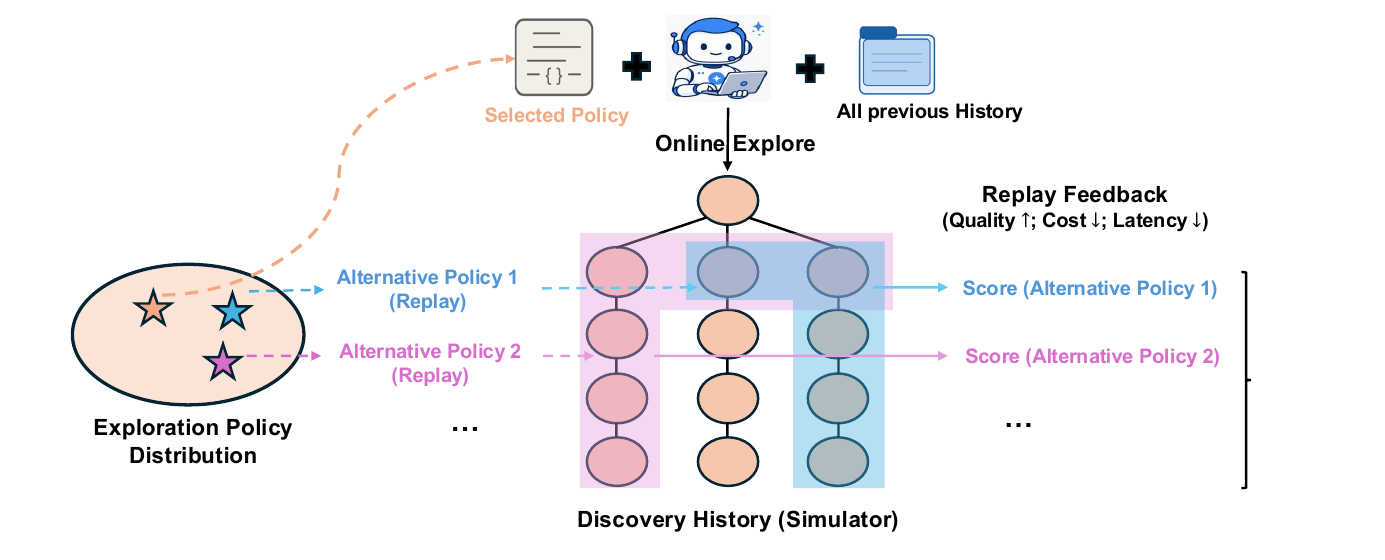
The key idea: a finished search is a tree of attempts whose scores are all stored. Another policy would walk the same tree differently: other branches, another order, an earlier stop. Its result can be read off the stored scores, without running the agent or the evaluator again. The agent "dreams" in its own history, much as a reinforcement-learning agent can learn inside a world model [6].
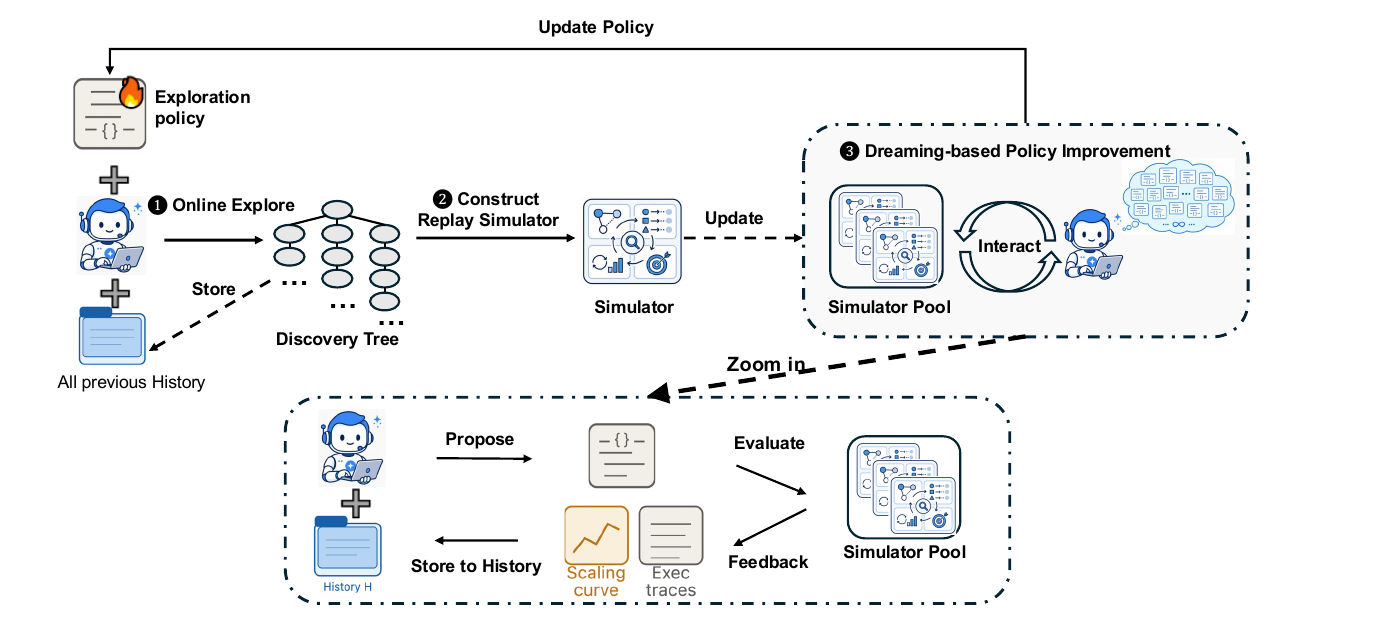
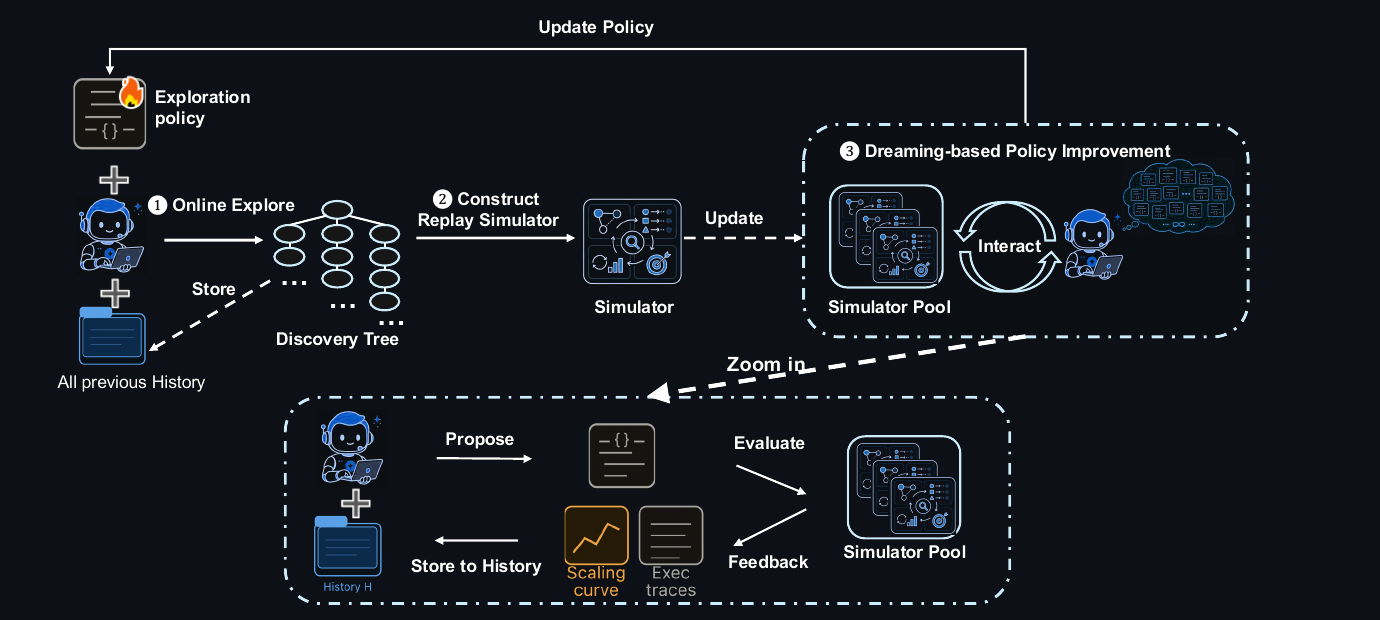
Each round, an agent rewrites the policy code, every version is replayed on all stored trees, and the best version, which may be the old one, runs the next search. Only the policy changes; the model, the coding agent, the evaluator and the task stay fixed. The baseline, Recursive Fixed Exploration, runs the same rounds and keeps the starting policy.
Results
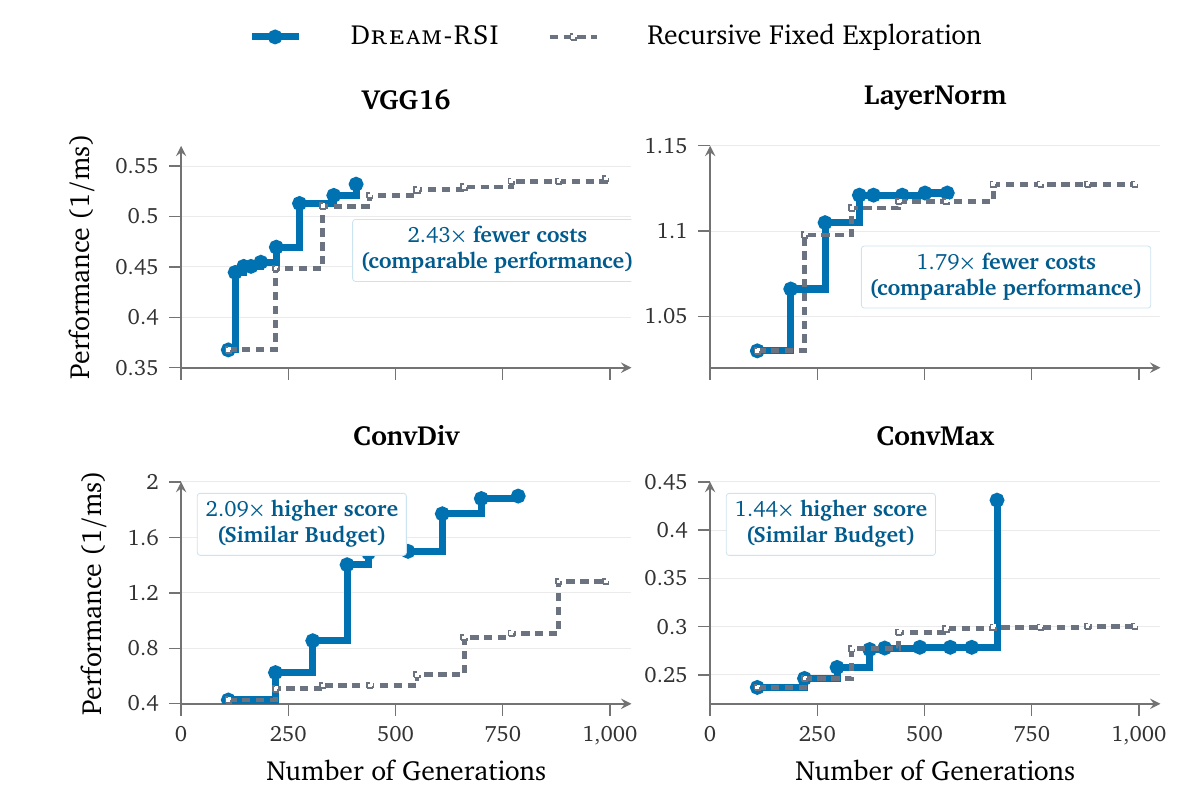
- GPU kernels (KernelBench), against the fixed policy: the same speed with 1.8–2.4× fewer generations, or up to 2.1× faster kernels for a similar budget (Fig. 3).
- Lasso path solver: faster than sklearn and glmnet on six held-out datasets, with up to 162× fewer agent calls than SimpleTES, which used a different model.
- Mathematical optimization: best or tied best of the compared methods on two of three problems.
- Harness search on Terminal-Bench 2.1: from 0.725 to 0.809, above Claude Code (0.75) and Meta-Harness (0.79) in the paper's setting.
HARNESS²: A HARNESS THAT IMPROVES HARNESSES
A harness is everything around a model that lets it act as an agent. Harness² edits eight parts of it: system prompt, guardrails, memory, tool guidance, subagents, skills, scripts and plugins. It does so on tasks the harness was not built for, where no answer key exists to check an edit against.
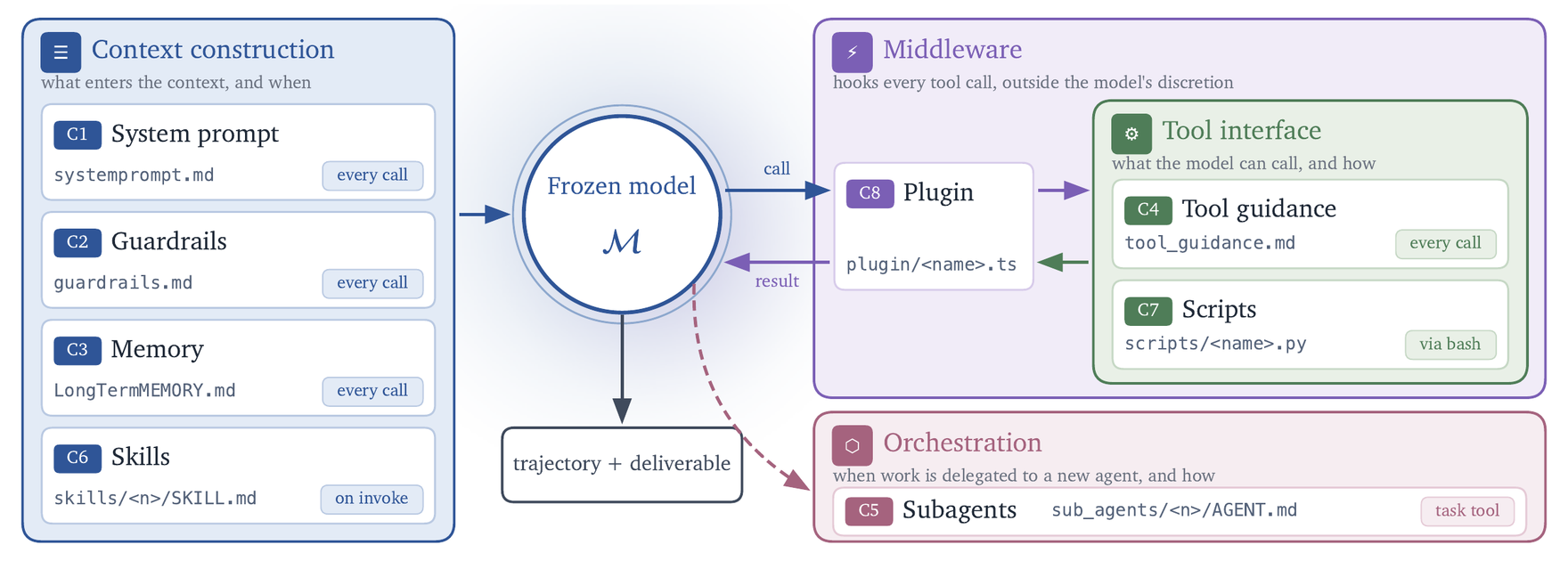
Two loops run on top of each other, with the model's weights fixed:
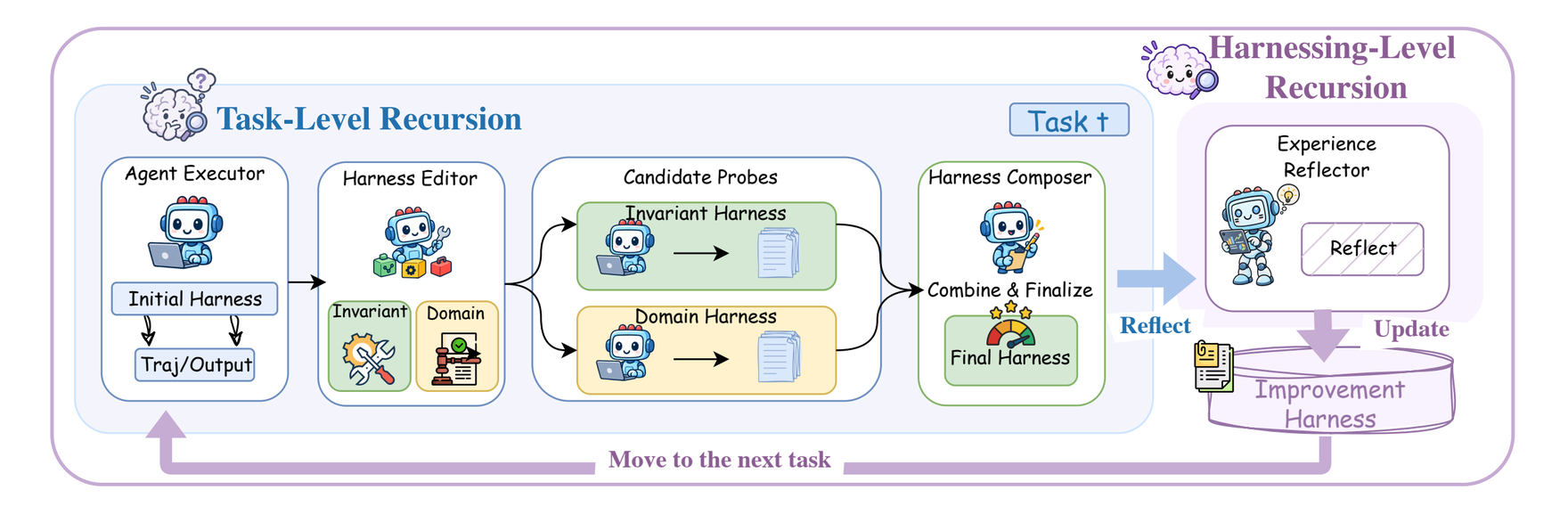
- Task level: Propose–Probe–Compose. After a reference run, an editor proposes two harnesses: one against weaknesses that recur in any domain, such as planning or tool use, and one for the task's domain. Each runs the same task. A composer compares the runs and keeps only the changes the comparison supports; this contrast replaces the missing answer key. More candidates in parallel, or more steps in sequence, help further.
- Harnessing level: after each task, a reflector stores the adopted harness and the lessons the evidence supports in an improvement harness. It guides the edits on the next task.
Results
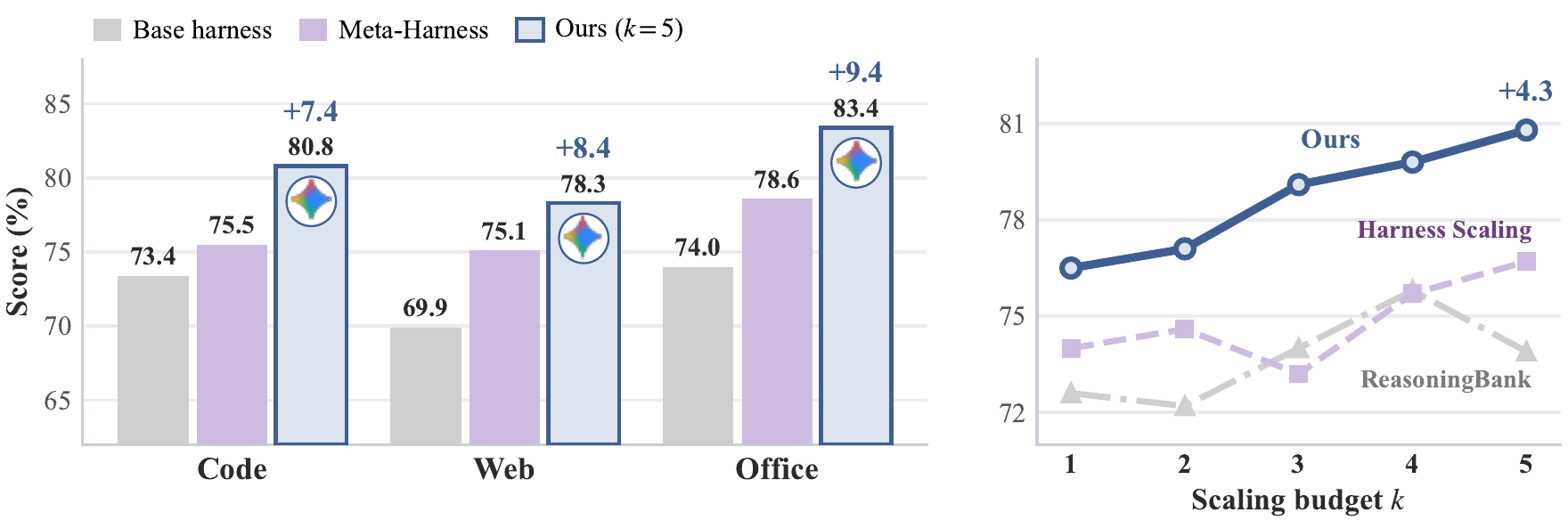
- Three benchmarks of professional work (WorkBuddy-Bench, JobBench, LAB) and four model–harness pairs with GLM-5 and Gemini 3.5 Flash: one step beats the base harness in every case, by up to 11.5 points on WorkBuddy-Bench, 4.5 points on JobBench and 11.8 percentage points on LAB's partial pass rate.
- A larger budget k keeps paying off (Fig. 6, right).
- Lessons transfer: a library of harnesses and lessons built on JobBench raises scores on WorkBuddy-Bench.
SIDE BY SIDE
| Dream-RSI | Harness² | |
|---|---|---|
| Changes | exploration policy (code) | harness (8 components) |
| Feedback | stored scores, replayed | contrast between probe runs |
| Needs a scorer | yes, a fixed evaluator | no |
| Carries over | replay worlds, across rounds | improvement harness, across tasks |
| Stays fixed | model, agent, evaluator, task | model weights |
| Tested on | kernels, Lasso, math, harness | office, web, code, jobs, law |
| Code | google-research/dream-rsi | google-research/harness2 |
IN σ-BENCH
- Dream-RSI runs σ-Bench's experiment loops (method). The implementation follows the paper and uses its prompts word for word; Claude Code, Codex and pi serve as coding agents.
- Harness² comes from Google's code (commit 1cfe254), unchanged, and runs its agents in the same sandbox.
- Both are frozen: any change to either needs a new version. No scored runs yet.
REFERENCES
- [1] T. Zheng et al. Dream-RSI: Recursive Self-Improvement through Evolving Worlds. arXiv:2609.14858, 2026. Code: github.com/google-research/dream-rsi. Project: github.com/zhengkid/Dream-RSI, dream-rsi.com.
- [2] R. Xu et al. Harness²: Recursive Agent Harnessing for an Open World. arXiv:2610.14224, 2026. Code: github.com/google-research/harness2. Project: harness2.github.io.
- [3] I. J. Good. Speculations concerning the first ultraintelligent machine. Advances in Computers 6, 1965.
- [4] E. Zelikman, E. Lorch, L. Mackey, A. T. Kalai. Self-Taught Optimizer (STOP): Recursively Self-Improving Code Generation. COLM, 2024. arXiv:2310.02304.
- [5] J. Zhang, S. Hu, C. Lu, R. Lange, J. Clune. Darwin Gödel Machine: Open-Ended Evolution of Self-Improving Agents. ICLR, 2026. arXiv:2505.22954.
- [6] D. Ha, J. Schmidhuber. World Models. arXiv:1803.10122, 2018.